
Missouri Criminal History Checks
No single Missouri search holds every Missouri criminal record. Start with the event or status that must be verified. The Missouri Automated Criminal History Site, known as MACHS, returns the Missouri Central Repository's public statewide history. Missouri Case.net shows public Missouri court events and some documents. A Missouri county sheriff or jail holds recent booking and custody data. The arresting police agency keeps its own narrative. The Missouri Department of Corrections covers active prison, probation, and parole status.
Names alone can point to the wrong person. Use an exact legal name and date of birth when the official Missouri system permits it, then compare the Missouri county, court, age, charge, and dates. A fingerprint check is the positive-identity route for reviewing one's own Missouri record. Follow this order:
- Choose MACHS for the statewide open criminal-history summary.
- Use Case.net to read filed charges, docket events, judgments, and hearing data.
- Open the county site for a booking, local report, or the clerk's source file.
- Check MODOC only for active state custody or state supervision.
- Confirm the final outcome with the court or agency that made the record.
Note: A statewide result is a useful index, but the source county record controls its own facts, copies, and later corrections.
Why Missouri Criminal Records Disagree
A Missouri MACHS result and a Missouri Case.net docket can both be accurate while looking different. Missouri law requires arresting agencies, prosecutors, courts, and corrections officials to report qualifying Missouri events to MSHP CJIS. Yet those events arrive at different times. A Missouri court can post a disposition before it is linked to the matching arrest cycle. An event may also be nonreportable, closed, expunged, or missed because a name inquiry used incomplete identifiers.
Public MACHS name results are possible Missouri identifier matches. They include the Missouri open-record class, such as convictions, arrests less than 30 days old, filed charges awaiting final disposition, and an SIS while probation remains active. They exclude closed Missouri records and FBI data. Missouri Case.net, by contrast, follows a court case, not a person's full history. When an outcome is wrong or absent in the repository, obtain the source disposition from the Missouri filing court and send the supporting record to CJIS.
The Criminal History Repository in Missouri
The Missouri State Highway Patrol Criminal Justice Information Services Division operates the statutory Central Repository. Section 43.500 RSMo defines that role. CJIS compiles reportable identity, arrest, prosecution, disposition, and correctional data from across Missouri. Its work also includes AFIS fingerprint matching, the sex offender registry, Uniform Crime Reporting, Rap Back notices, criminal-history research, and statewide information-system support.
The public MACHS name check costs $15 plus the Missouri payment-processing charge. A mailed Missouri name request also costs $15. For a positive-match Missouri review, a fingerprint check carries a $20 state fee and a $12 IDEMIA capture fee. An authorized Missouri and FBI channel adds a $12 FBI component. A notarized response costs another $5. These are Missouri statewide fees; court copies and local public-record work follow separate schedules.
Missouri's repository is updated daily, but daily updates do not promise a complete Missouri file. MSHP warns that a known Missouri event may produce no record because an agency never submitted it or the offense did not meet section 43.506 reporting rules. Fingerprints and the Missouri offense cycle number help link an arrest with the later court result.
Note: Missouri repository fee totals can change at checkout, so confirm the official MACHS display before submitting any paid record search.
MACHS Missouri Record Search Fields
The Missouri MACHS public name portal requires an account. A Missouri search uses first and last name plus an exact date of birth or Social Security number. Middle name can narrow a match, and the Missouri form accepts up to two alias or maiden-name groups. Incorrect submitted searches are not refundable. Missouri results remain in the account for 90 days, while research cases may remain pending for several business days.
The official MACHS Name Search gateway shows the account and login path used for Missouri criminal history requests:
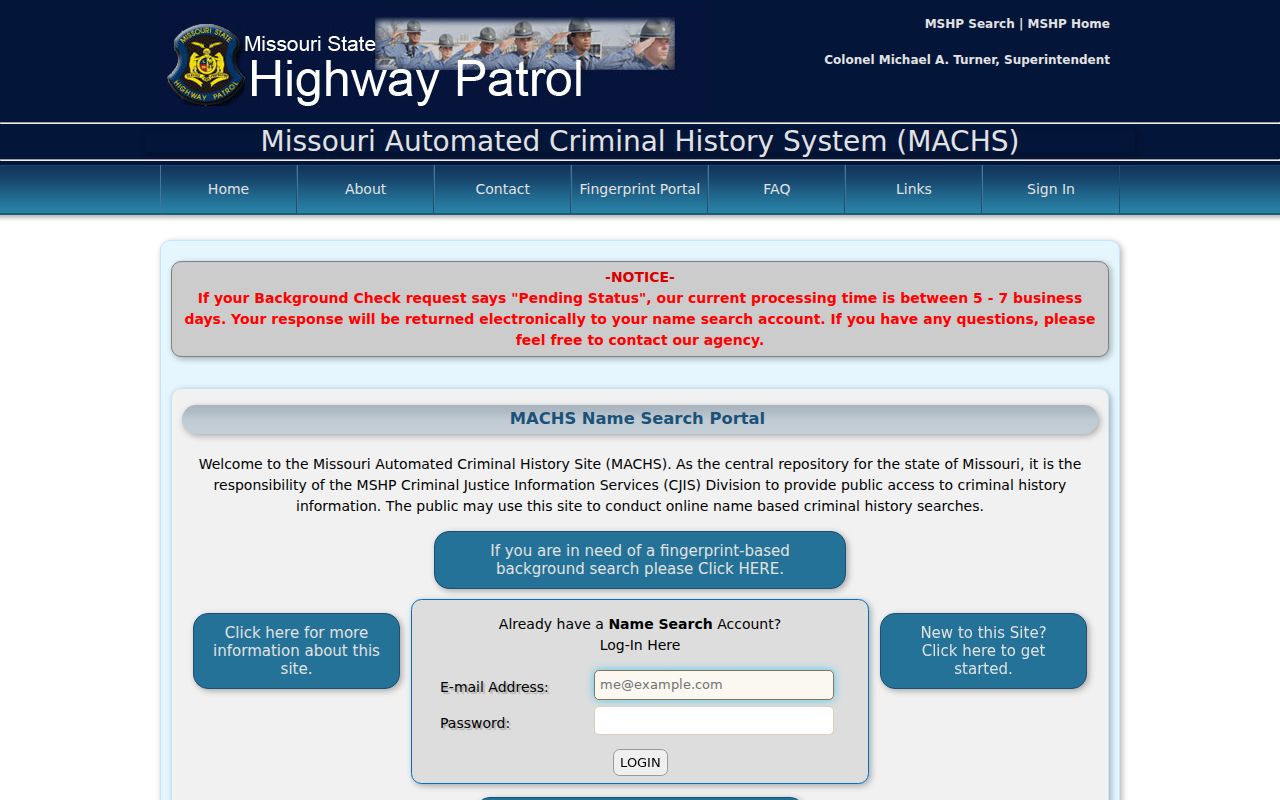
The screen leads to the secure inquiry, payment, purchase-history, and PDF response workflow.
| Field | Required | Use |
|---|---|---|
| First and last name | Yes | Core subject identifiers |
| Date of birth or SSN | One is required | Narrows possible matches |
| Middle name | No | Adds identity detail |
| Two alias groups | No | Checks prior or maiden names |
| Payment | Yes | $15 plus processing |
Record Systems Across Missouri
Missouri divides criminal records by purpose. The repository gives an identity-centered history. Case.net provides court-centered information. MODOC Offender Search covers active state prisoners, probationers, and parolees, subject to listed safety and confidentiality limits. The Missouri Sex Offender Registry is a separate public safety system maintained by MSHP CJIS with local registration and verification.
Each Missouri system has a limit. Case.net is not a Missouri rap sheet. MODOC does not list Missouri county jail rosters or discharged people. Registry profiles are not complete Missouri criminal histories and are not individual risk findings. The Missouri county clerk, sheriff, jail, or police department remains vital when the statewide layer lacks a source document.
| System | Best Use | Run By |
|---|---|---|
| MACHS | Missouri open criminal history | MSHP CJIS |
| Missouri Case.net | Public state court cases | Missouri Judiciary |
| MODOC Offender Search | Active prison or supervision status | Missouri Department of Corrections |
| Missouri Sex Offender Registry | Public registration data | MSHP CJIS and local officials |
Note: Search each Missouri system by purpose because no statewide portal replaces the original police, jail, court, or federal record.
Missouri Warrant Records Need Local Checks
Missouri has no comprehensive public statewide warrant search. Restricted law-enforcement systems such as MULES and NCIC are not public portals. Public checking starts with Case.net docket events, then moves to the sheriff and the issuing circuit or municipal court. Terms such as warrant, capias, failure to appear, or warrant recalled may appear in a public case, but an unserved sealed indictment or active investigative detail may remain unavailable.
A Missouri warrant must be resolved with the issuing court, not through an online listing. Confirm the Missouri case number, court, current status, and instructions through official contacts. Municipal warrants may not appear on a Missouri county sheriff page, so the court division matters. If the record is unclear, use the county directory to reach the correct local system. Do not rely on an unofficial caller's demand for payment as proof that a warrant is valid or cleared.
Missouri Criminal Record Types
Missouri criminal records follow the office that created them. An arrest report comes from the arresting agency. A jail booking comes from the local custody system. A charging document and judgment belong to the court file. The repository joins reportable events around an identity, while corrections and registry records serve their own statutory purposes.
- Rap sheet
- A chronological repository summary of identity, arrests, charges, outcomes, and correctional events.
- Disposition
- The recorded result of a charge, such as conviction, dismissal, acquittal, or nolle prosequi.
- SIS
- A suspended imposition of sentence, which can be public during probation and become confidential after successful completion.
- SES
- A suspended execution of sentence, where the court imposes a sentence but suspends its execution under conditions.
- OCN
- The offense cycle number used to connect a Missouri arrest with later prosecution and disposition reporting.
The official Missouri UCR dashboard adds aggregate crime and arrest counts rather than person-level records:
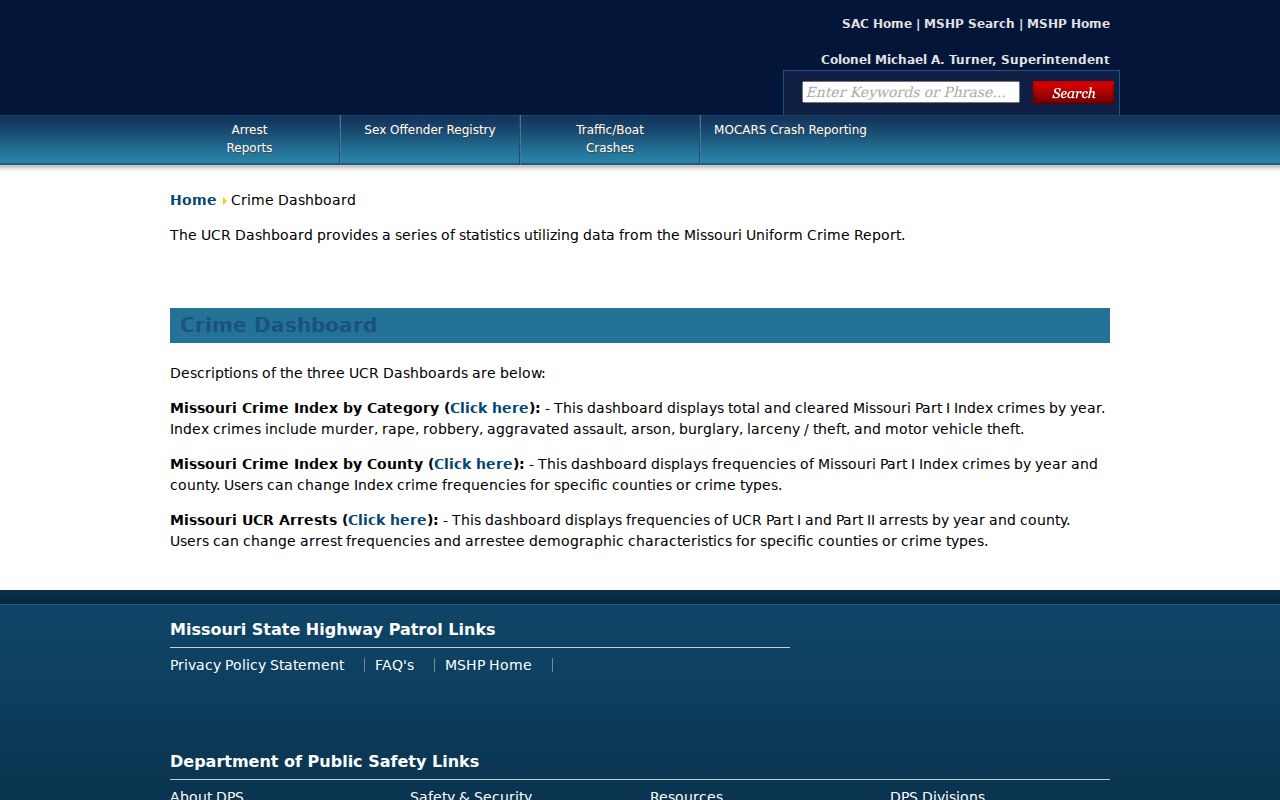
Its year, county, offense, and demographic controls help measure reported events, but a count is not a list of people or convictions.
Missouri Custody Records Split Three Ways
Custody searches divide into local, state, and federal layers. County jails hold many recent arrestees, people awaiting trial, and some locally sentenced detainees. Missouri has no universal county jail roster. MODOC operates 21 adult correctional centers and its Offender Search covers active incarcerated people plus active probationers and parolees. It omits discharged people and may suppress data for safety or confidentiality.
Federal imprisonment uses the Bureau of Prisons locator. Federal court dockets use PACER through Missouri's Eastern or Western District, not Missouri Case.net. Missouri VINELink can add custody-status notifications for participating Missouri agencies, but it is not a criminal-history check. A person can appear in more than one layer from separate matters, so check the jurisdiction that handled the event.
Note: A jail roster describes custody at a point in time and does not prove that a filed charge ended in conviction.
Missouri Supervision Records Explained
Felony probation is state-run in Missouri. Circuit courts place people on probation, while the Missouri Department of Corrections Division of Probation and Parole provides supervision. The Missouri Parole Board makes discretionary parole decisions, and the same division supervises parole and conditional release. MODOC materials describe roughly 60,000 Missourians on probation or parole, with districts, satellites, community supervision centers, transition centers, and institutional parole offices.
The official MODOC Probation and Parole overview shows the statewide structure and its named rulebooks:
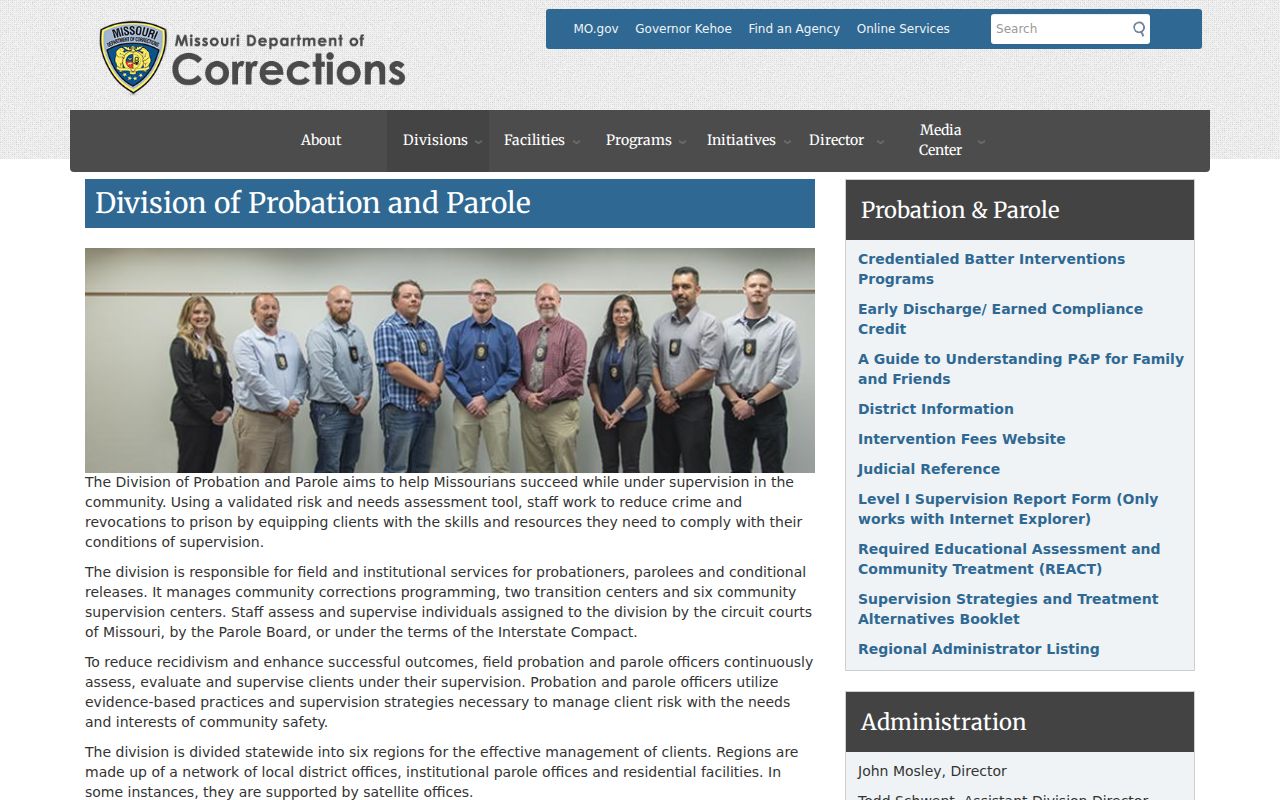
The White Book addresses supervision conditions, the Blue Book covers parole and conditional release decisions, and the Orange Book addresses sex-offender supervision conditions.
Use Case.net and the circuit clerk to confirm that a court imposed probation. Use MODOC Offender Search for active supervision status. A new arrest or warrant is not the same as a final revocation. The court controls probation revocation, while the Parole Board and MODOC process control parole or conditional-release action.
Note: MODOC status is active custody or supervision data, not a complete Missouri criminal history or county court case file.
Missouri Record Access Laws
The Missouri Sunshine Law sets the broad public-record baseline, but Missouri access is source-specific. Missouri court files follow judiciary rules. Repository dissemination follows Missouri criminal-history statutes. Arrest and investigative records can change status as a Missouri case develops. Juvenile, victim, sealed, and expunged material can be restricted. A Missouri request goes to the body that holds the record, not to the Attorney General as a central records warehouse.
Key Missouri authorities:
Chapter 610 RSMo sets Sunshine Law access, response, closure, and fee rules.
Section 610.100 RSMo distinguishes arrest, incident, and investigative reports.
Section 43.506 RSMo defines reportable offenses for repository purposes.
Section 610.140 RSMo governs the main petition-based expungement process.
Section 211.321 RSMo generally protects juvenile court and peace-officer records.
Missouri Police Records Stay Local
Missouri does not maintain one statewide archive of every sheriff and city-police narrative. Ask the agency that investigated for its incident or arrest report. A written Sunshine request should give the type of record, date range, location, case or incident number, county, and preferred format. The custodian must respond by the third business day, though a reasonable production delay may follow. Closed investigative material, protected identifiers, juvenile details, and victim information may be withheld or redacted.
MSHP-created reports use the Patrol's Public Records Center. Patrol crash reports follow a separate channel and a basic report currently costs $6. The preliminary crash page covers only injury or fatal crashes investigated by MSHP and keeps online entries for one year. It is not an arrest search.
The official MSHP preliminary crash search shows filters for county, troop, location, date, injury type, and incident number:
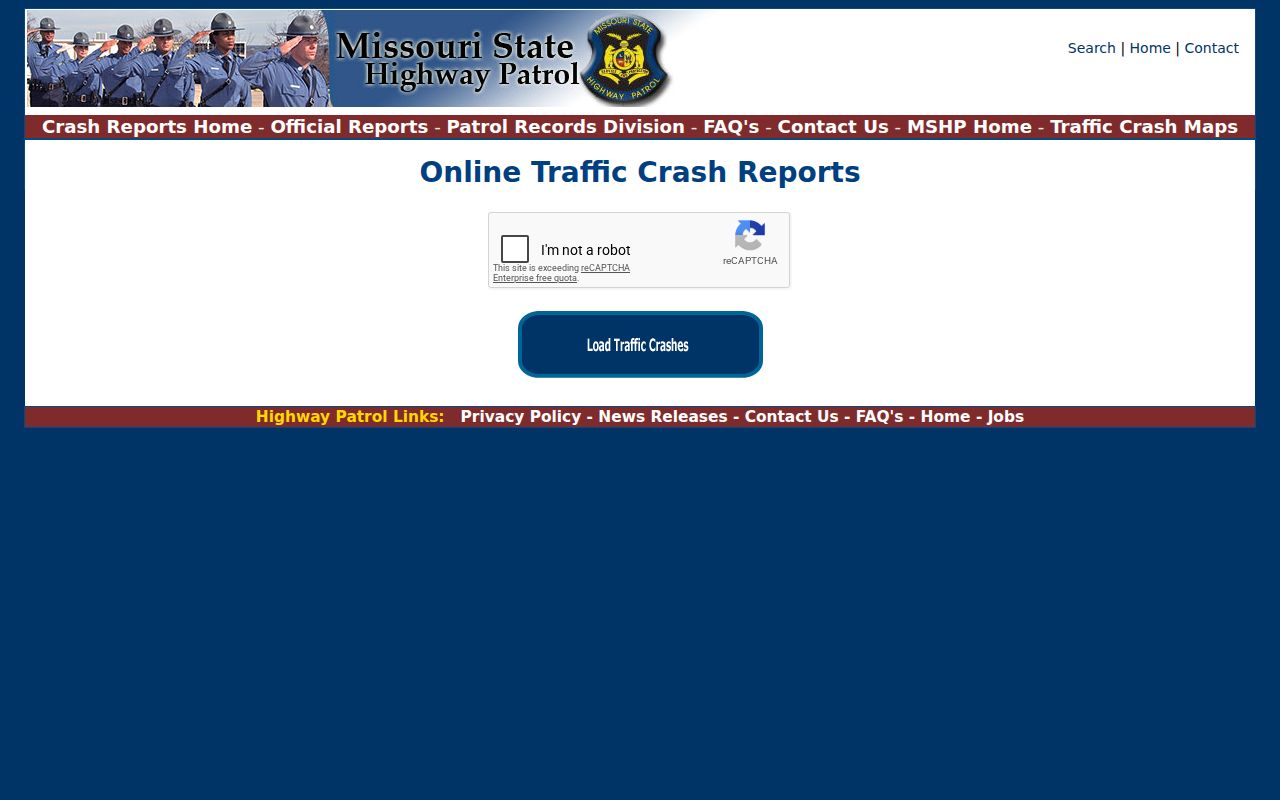
The interface illustrates why record type and creating agency must be identified before a request is sent.
Missouri Crime Classes in Context
Missouri's charge class helps explain the possible custody range, but it does not prove the result, public status, or actual sentence. The filed judgment controls. Enhancements and offense-specific statutes can also change the range. Felonies generally proceed in Circuit Court, while misdemeanors often run through an associate circuit division. Municipal ordinance matters remain within municipal divisions of the circuit system.
| Missouri Level | Authorized Imprisonment |
|---|---|
| Class A felony | 10 to 30 years or life |
| Class B felony | 5 to 15 years |
| Class C felony | 3 to 10 years |
| Class D felony | Up to 7 years |
| Class E felony | Up to 4 years |
| Class A misdemeanor | Up to 1 year |
| Class B misdemeanor | Up to 6 months |
| Class C misdemeanor | Up to 15 days |
Section 558.016 can authorize higher ranges for defined persistent or dangerous offenders. Always read the charge code, later amendments, disposition, and sentence together.
Missouri Expungement Starts in Court
Missouri expungement under section 610.140 begins in the municipal, associate circuit, or circuit court that handled the matter. The petition lists each crime, approximate charge date, county or municipality, case number, court, and every agency believed to hold the record. An omitted agency is not affected by the order. Current law excludes major categories such as class A felonies, dangerous felonies, registration-triggering sex offenses, and other listed crimes.
Eligibility also depends on pending charges, statutory criteria, paid obligations including restitution, conduct, and public welfare. A prosecutor may object after service. If granted, the public court file becomes confidential as directed, while limited criminal-justice uses can remain. Keep the signed order. Then check Case.net and obtain a new fingerprint-based personal record from CJIS. If the event still appears, send the order and source documents to the agency that must correct it.
Missouri also uses automatic expungement or vacatur processes for specified marijuana offenses under Article XIV. Those processes do not turn every other criminal record into an automatic removal.
Missouri Criminal Records by County
Missouri consists of 114 counties and the independent City of St. Louis, which functions as its own county-equivalent records system. Arrest reports, bookings, local warrants, and the court's source file are created at this level. The most direct path is the county or independent city where the arrest occurred or the case was filed.
St. Louis County
Clayton · Missouri's most populous county and a large circuit and municipal records network
Jackson County
Independence · Major Kansas City metro court and detention systems
St. Charles County
St. Charles · Fast-growing metro with distinct county and city record channels
Greene County
Springfield · Southwest Missouri court, jail, and supervision hub
Clay County
Liberty · Northland county with several city police and municipal systems
Jefferson County
Hillsboro · Large St. Louis exurban booking and circuit record system
Boone County
Columbia · Central Missouri circuit, sheriff, and public-safety hub
St. Louis City
St. Louis · Independent city with its own circuit and justice agencies
Browse the full directory of all 115 Missouri county-level sites to reach the correct local criminal records sources.